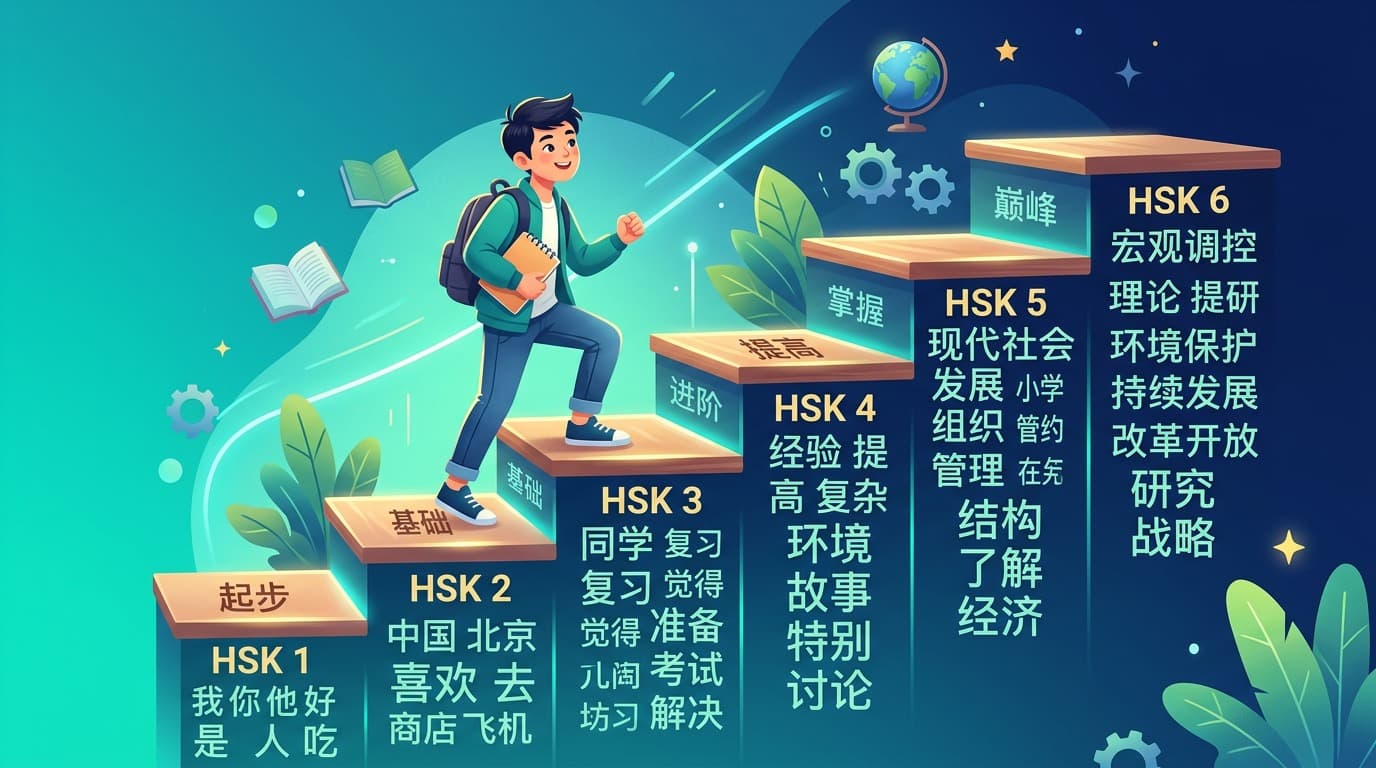
The HSK (汉语水平考试, Hànyǔ Shuǐpíng Kǎoshì) is China's standardized test for Chinese language proficiency. Whether you need it for university admission, employment, or just as a benchmark for your own progress, understanding what each level requires is essential.
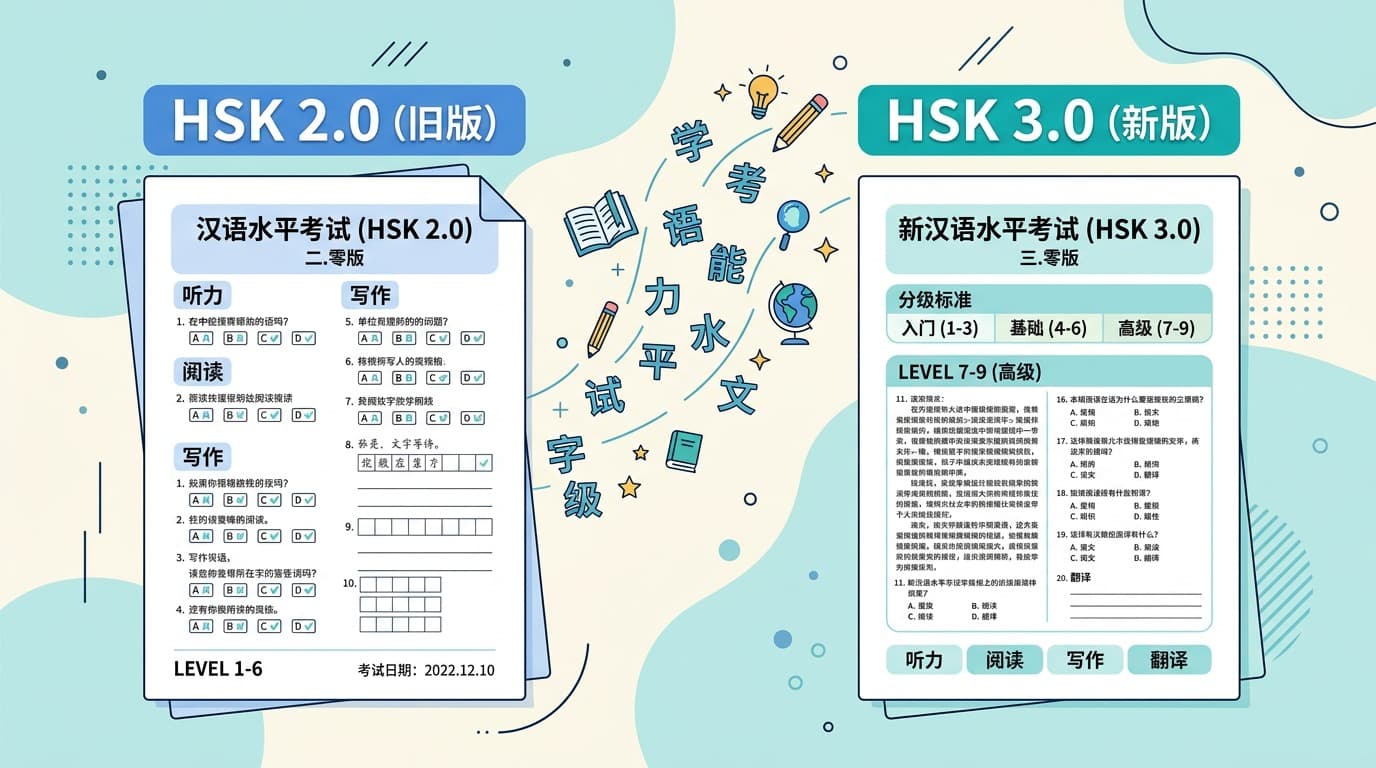
This guide covers the HSK 3.0 system (current as of 2026) with practical details about what you can actually do at each level.
HSK 1: The Foundation (300 words)
CEFR equivalent: A1
What you can do: - Introduce yourself and answer basic questions - Count, tell time, talk about dates - Order food and drinks - Go shopping (ask prices, pay) - Talk about family members and friends - Describe weather simply
Example sentences you can understand: - 你好,我叫小明。(Hello, my name is Xiao Ming.) - 现在几点?(What time is it now?) - 这个多少钱?(How much is this?) - 明天天气怎么样?(How's the weather tomorrow?)
Exam format: Listening + Reading (no writing) - 40 questions, 40 minutes - Pass mark: 120/200
Real-world feel: You can survive basic tourist situations. You can read simple signs and menus with pinyin support. Conversations are limited to rehearsed patterns.
Study tip: Focus on mastering these 300 words thoroughly — with correct tones — rather than rushing to HSK 2. A solid HSK 1 foundation makes everything after easier.
HSK 2: Building Blocks (600 cumulative words)
CEFR equivalent: A2
What you can do: - Give and understand simple directions - Talk about hobbies and daily routines - Make basic comparisons (bigger, better, more) - Describe people's appearance - Handle simple phone calls - Express basic emotions and preferences
Example sentences: - 从这儿到地铁站怎么走?(How do I get to the subway station from here?) - 我比他高。(I'm taller than him.) - 虽然很累,但是我很开心。(Although I'm tired, I'm happy.) - 你有什么爱好?(What hobbies do you have?)
Exam format: Listening + Reading (no writing) - 55 questions, 55 minutes - Pass mark: 120/200
Real-world feel: You can have short conversations with patient speakers. You understand the gist of simple texts. Restaurant menus and transportation signs become readable.
HSK 3: The Breakthrough (1,200 cumulative words)
CEFR equivalent: B1
What you can do: - Express opinions and explain reasons - Describe past experiences and future plans - Handle most travel situations independently - Read simple articles and short stories - Write short messages and emails - Understand the main points of clear speech on familiar topics
Example sentences: - 如果明天不下雨,我们就去公园。(If it doesn't rain tomorrow, we'll go to the park.) - 这个城市的环境越来越好了。(This city's environment is getting better and better.) - 我觉得学习语言最重要的是坚持。(I think the most important thing in language learning is persistence.)
Exam format: Listening + Reading + Writing - 80 questions + short writing, 90 minutes - Pass mark: 180/300
Real-world feel: This is where Chinese starts feeling useful. You can travel independently, make friends, follow TV shows with subtitles, and read simple social media posts. Many learners describe HSK 3 as the "aha moment" — where study finally translates to real communication.
HSK 4: Functional Fluency (2,400 cumulative words)
CEFR equivalent: B2
What you can do: - Discuss abstract topics (society, education, environment) - Read news articles and blog posts - Write structured paragraphs and short essays - Understand most TV shows and podcasts - Participate in group discussions - Handle work situations in Chinese
Example sentences: - 随着科技的发展,我们的生活方式发生了很大的变化。(With the development of technology, our lifestyles have changed greatly.) - 无论遇到什么困难,我们都不应该放弃。(No matter what difficulties we encounter, we shouldn't give up.) - 这个问题值得我们认真考虑。(This issue deserves our serious consideration.)
Exam format: Listening + Reading + Writing - 100 questions + essay writing, 105 minutes - Pass mark: 180/300
Real-world feel: You're functional. You can work in a Chinese-speaking office for routine tasks, follow meetings, write emails, and socialize. Reading is comfortable for everyday content. You still struggle with rapid speech, slang, and highly specialized topics.
This level is often required for: Undergraduate admission at Chinese universities, basic professional roles.
HSK 5: Advanced Proficiency (4,316 cumulative words)
CEFR equivalent: C1
What you can do: - Read Chinese newspapers and magazines fluently - Watch movies and shows without subtitles (mostly) - Write formal documents, reports, and academic texts - Debate and discuss nuanced topics - Understand lectures and presentations - Use idioms and set phrases appropriately
Example sentences: - 这部小说深刻地反映了当代社会的矛盾与挑战。(This novel profoundly reflects the contradictions and challenges of contemporary society.) - 尽管双方意见不一致,但最终还是达成了共识。(Although both sides disagreed, they ultimately reached a consensus.) - 他的演讲不仅内容丰富,而且表达方式也很生动。(His speech was not only rich in content but also vivid in expression.)
Exam format: Listening + Reading + Writing - 100 questions + composition, 125 minutes - Pass mark: 180/300
Real-world feel: You're comfortable in almost all situations. You read novels for pleasure, argue about politics, and catch cultural references. The main gaps are very specialized vocabulary (legal, medical, technical) and some dialect expressions.
This level is often required for: Graduate school admission, professional positions, journalism, translation work.
HSK 6: Mastery (6,395 cumulative words)
CEFR equivalent: C1+
What you can do: - Understand virtually everything you hear or read - Express yourself fluently, precisely, and with nuance - Read classical Chinese references and literary allusions - Write academic papers and professional reports - Navigate formal and diplomatic language - Understand humor, sarcasm, and cultural subtext
Example sentences: - 这项政策的实施对于促进区域经济协调发展具有深远的意义。(The implementation of this policy has far-reaching significance for promoting coordinated regional economic development.) - 纵观历史,凡是能够与时俱进的文明,都展现出了强大的生命力。(Throughout history, civilizations that have kept pace with the times have all demonstrated powerful vitality.)
Exam format: Listening + Reading + Writing - 101 questions + summary writing, 140 minutes - Pass mark: 180/300
Real-world feel: You operate at a near-native level for professional and academic purposes. You can read government documents, academic journals, and literary criticism. Native speakers treat you as fully fluent.
Beyond HSK 6: The Advanced Bands (7-9)
HSK 3.0 introduced three additional bands tested in a single combined exam. These levels cover: - Academic and professional Chinese at the highest level - Classical Chinese (文言文) references - Specialized terminology across multiple fields - ~11,000 cumulative words
Most learners never need HSK 7-9 unless they're pursuing academic careers in Chinese studies, diplomatic work, or high-level translation.
How to Prepare Efficiently
Regardless of your target level, the most efficient approach is the same:
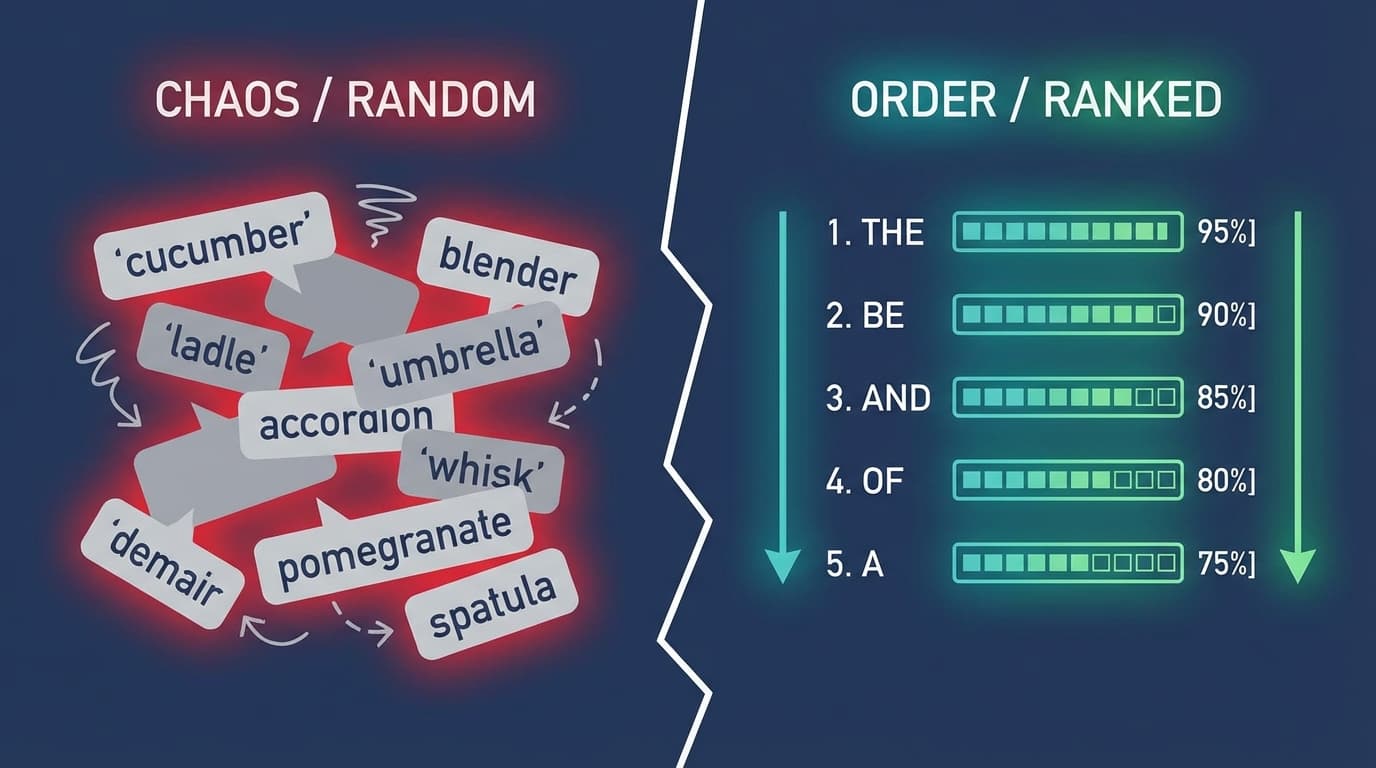
1. Learn vocabulary by frequency, not by HSK level. The most common words overlap heavily with HSK vocabulary. A frequency-based curriculum covers HSK requirements naturally.
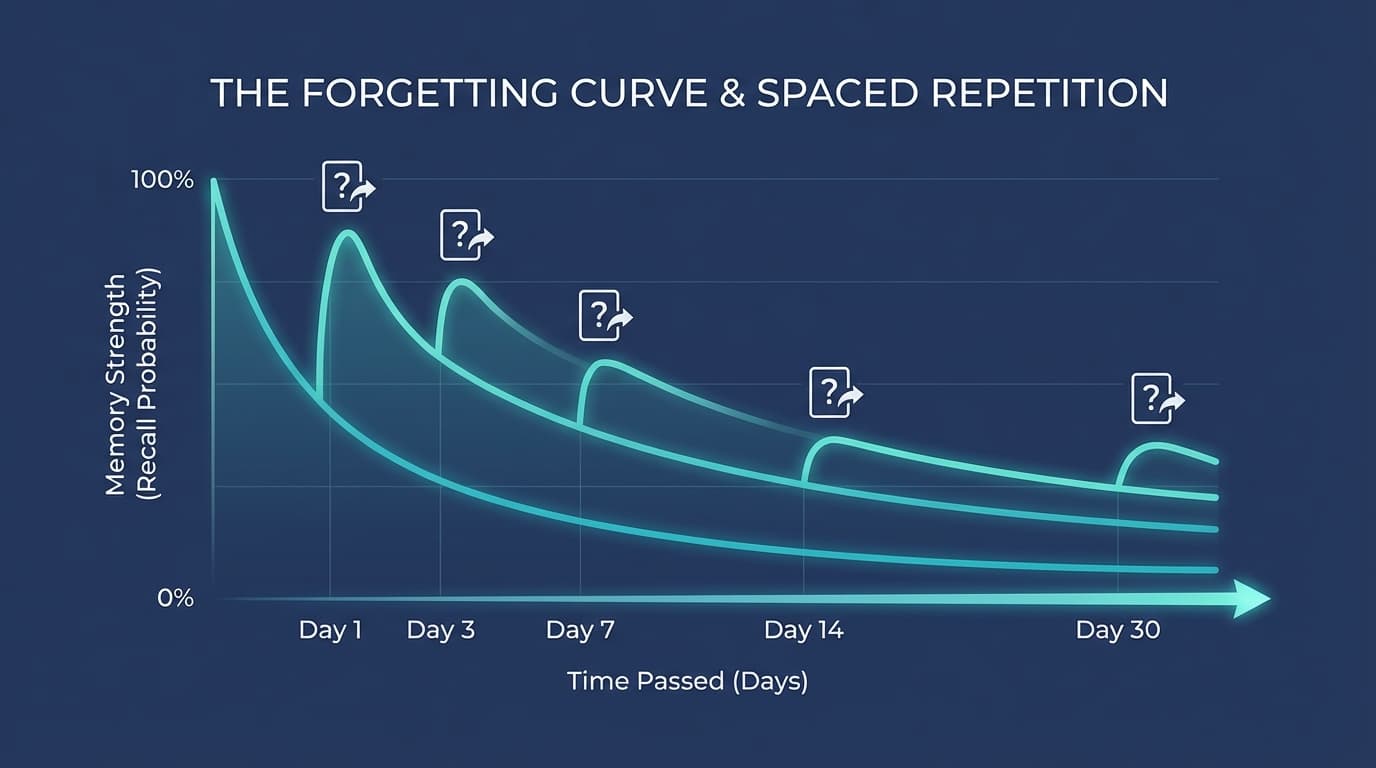
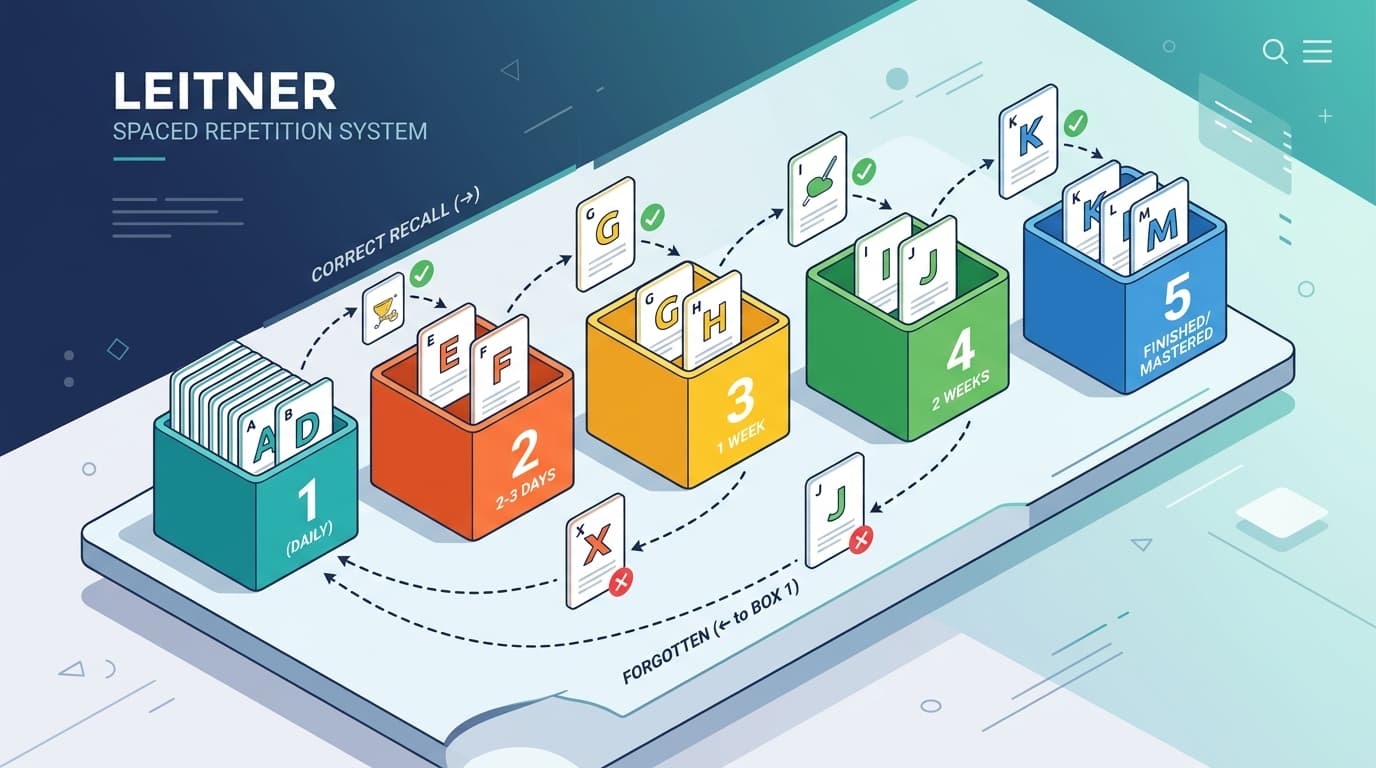
2. Use spaced repetition. The Leitner system or similar SRS ensures you retain what you learn without wasting time on words you already know.
3. Read and listen at your level. Graded content — sentences, stories, and dialogs matched to your vocabulary — builds comprehension without overwhelming you.
4. Take practice exams. Familiarity with the exam format is worth 10-20 points. The question types, timing, and format matter.
5. Don't obsess over the test. HSK is a benchmark, not a goal. Learn Chinese well, and HSK scores follow naturally.
Insperium covers all HSK 3.0 vocabulary through its frequency-based curriculum. The HSK overlay on your dashboard shows your readiness for each level and identifies exactly which words you need to fill any gaps.