Here's the good news: you don't need to memorize a dictionary.
One of the most consistent findings in linguistics is that a small number of words does most of the heavy lifting in any language. Whether it's English, Chinese, Spanish, or Dutch — the math is remarkably similar.
The answer to "how many words do I need?" is a lot lower than most people think.
The Zipf Principle: Why a Few Words Dominate
In the 1930s, linguist George Zipf noticed something strange: in any large body of text, a tiny fraction of words shows up constantly, while the vast majority barely appear at all.
This isn't a quirk — it's a law. And it holds across every language ever studied.
Think about your own speech for a moment. How often do you say "the," "is," "have," "go," "want," "know"? Now think about the last time you said "saucepan" or "chandelier." That's Zipf's Law in action.
Modern researchers have quantified this with massive language databases called corpora — millions of real sentences from conversations, TV shows, books, and news. The numbers tell a clear story.
The Coverage Table: What the Research Says
Linguist Paul Nation and colleagues have measured how much of everyday language you can understand based on vocabulary size:
| 500 words | ~60–65% |
| 1,000 words | ~75–80% |
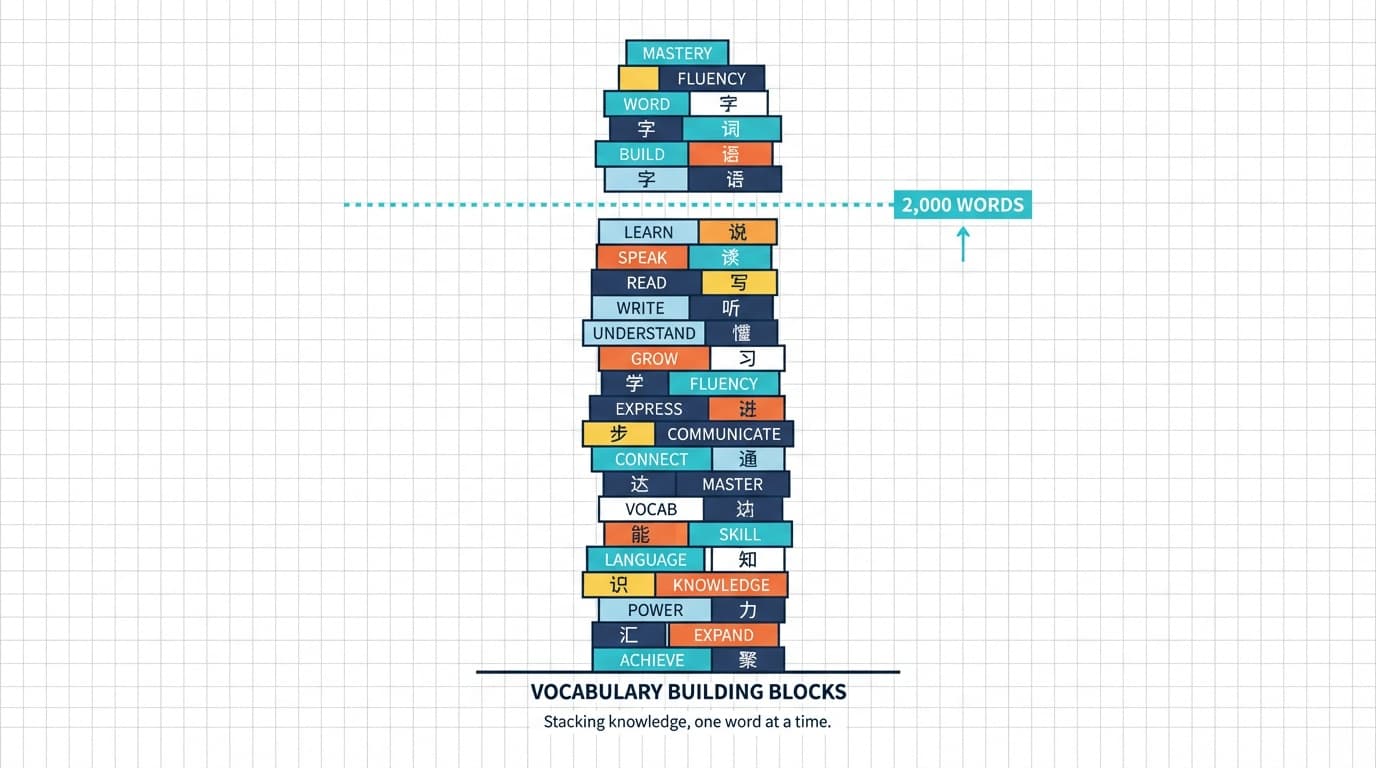
| 2,000 words | ~85–90% |
| 3,000 words | ~92–95% |
| 8,000–9,000 words | ~98% |
The pattern is dramatic: the first 2,000 words give you the biggest jump in comprehension. After that, each new word contributes less and less.
This is sometimes called the law of diminishing returns in vocabulary acquisition — and it's the single most important insight for anyone learning a language.
Two Thresholds That Matter
Researchers have identified two critical levels:
95% coverage — You understand the main ideas. You can follow conversations, read simple articles, and get by in most daily situations. Some details are fuzzy, but you're functional. This requires roughly 3,000 words.
98% coverage — You read comfortably without a dictionary. Conversations flow naturally. This is where fluency feels real — but it takes 8,000–9,000 word families.
Here's the thing: spoken language is simpler than written language. Studies of spoken corpora show that most daily conversations rely on just 2,000–3,000 words. You can start having real conversations long before you hit advanced levels.
Why Learning the Right Words Matters More Than Learning More Words
With 1,000 words you can handle basic situations. With 2,000–3,000, you can navigate most of daily life. With 5,000+, you're approaching fluency.
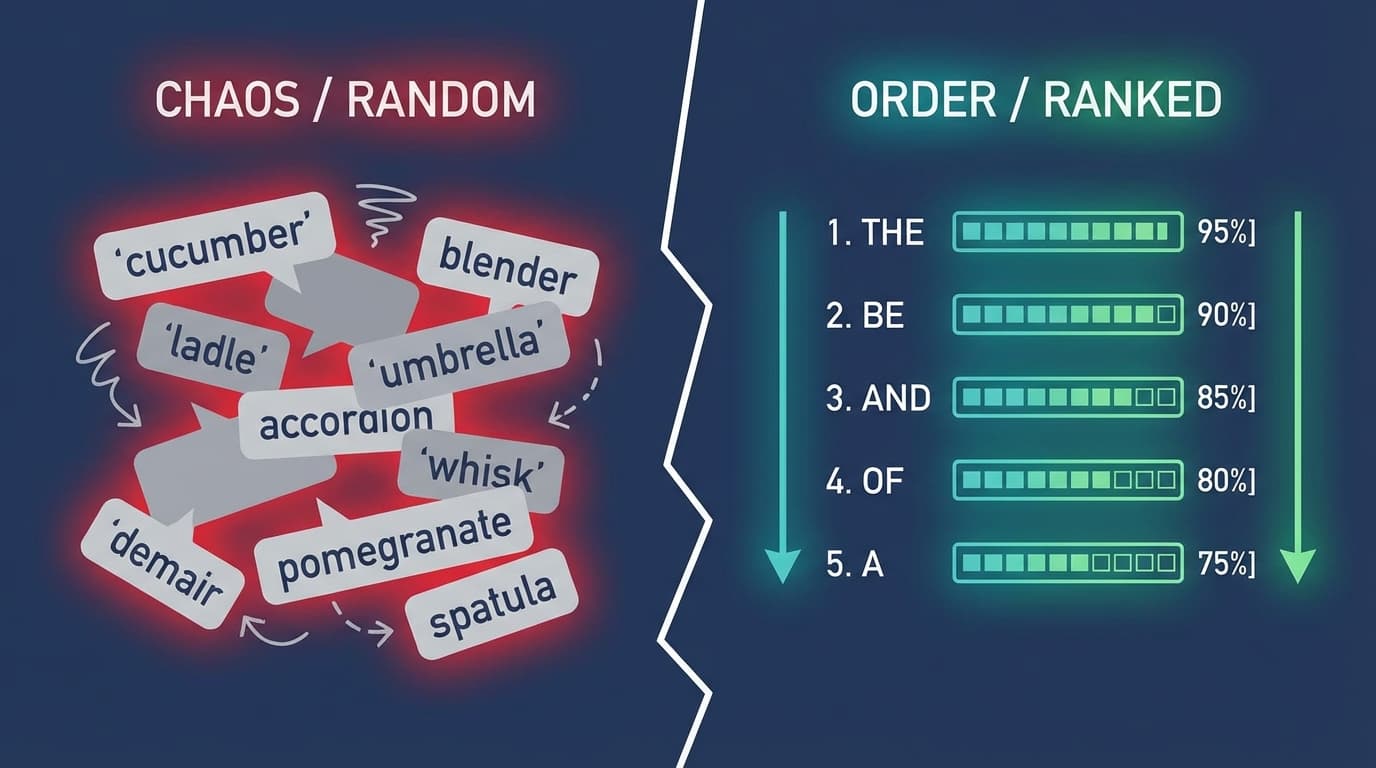
But only if you learn the right words. Learning "blender" before "because" — which many textbooks do — is a waste of your most valuable study hours.
This is why frequency-based learning exists: instead of organizing vocabulary by random themes, you learn words in the order they actually appear in real communication. The payoff is faster because every word you learn is one you'll encounter constantly.
Words Don't Exist Alone
Research by linguists like John Sinclair and Alison Wray shows that language is full of recurring patterns: "make a decision," "take a break," "pay attention." These aren't random — they're how native speakers actually talk.
Learning vocabulary inside sentences rather than as isolated flashcards helps you absorb these patterns naturally. You don't just learn what a word means — you learn how it behaves.
The Practical Roadmap
Based on the research, an efficient vocabulary progression looks like this:
First 1,000 words — Basic communication. Survival phrases. Core verbs and function words. You can order food, ask directions, and understand simple conversations.
2,000–3,000 words — Comfortable everyday conversation. Most spoken language situations. This is where language starts feeling useful rather than frustrating.
4,000–6,000 words — Intermediate fluency. You follow most media, discussions, and reading material.
8,000+ words — Advanced comprehension. Complex texts, nuanced conversation, professional contexts.
The early stages provide the greatest gains — which is exactly why you should optimize for speed there.
How Getinsperium Applies This
Getinsperium's entire curriculum is built on this principle. Our 4,050 words are organized in 54 blocks of 75 words each, ranked by real-world frequency from the SUBTLEX corpus (33 million words of real Chinese media).
Block 1 gives you the 75 most common words. By Block 10, you understand basic conversations. By Block 27, you've crossed the 2,000-word threshold that unlocks 85–90% comprehension.
Every sentence, dialog, and story in the platform uses only vocabulary you've already learned — so you're always reading at your level, reinforcing what you know while adding what's next.
References
- Zipf, G. K. (1935). The Psycho-Biology of Language.
- Nation, I. S. P. (2001). Learning Vocabulary in Another Language.
- Nation, I. S. P. (2006). Vocabulary size and text coverage.
- Laufer, B., & Ravenhorst-Kalovski, G. (2010). Lexical threshold for reading comprehension.
- Cepeda, N. J., et al. (2006). Distributed practice in verbal recall tasks.
- Dunlosky, J., et al. (2013). Improving students' learning with effective learning techniques.