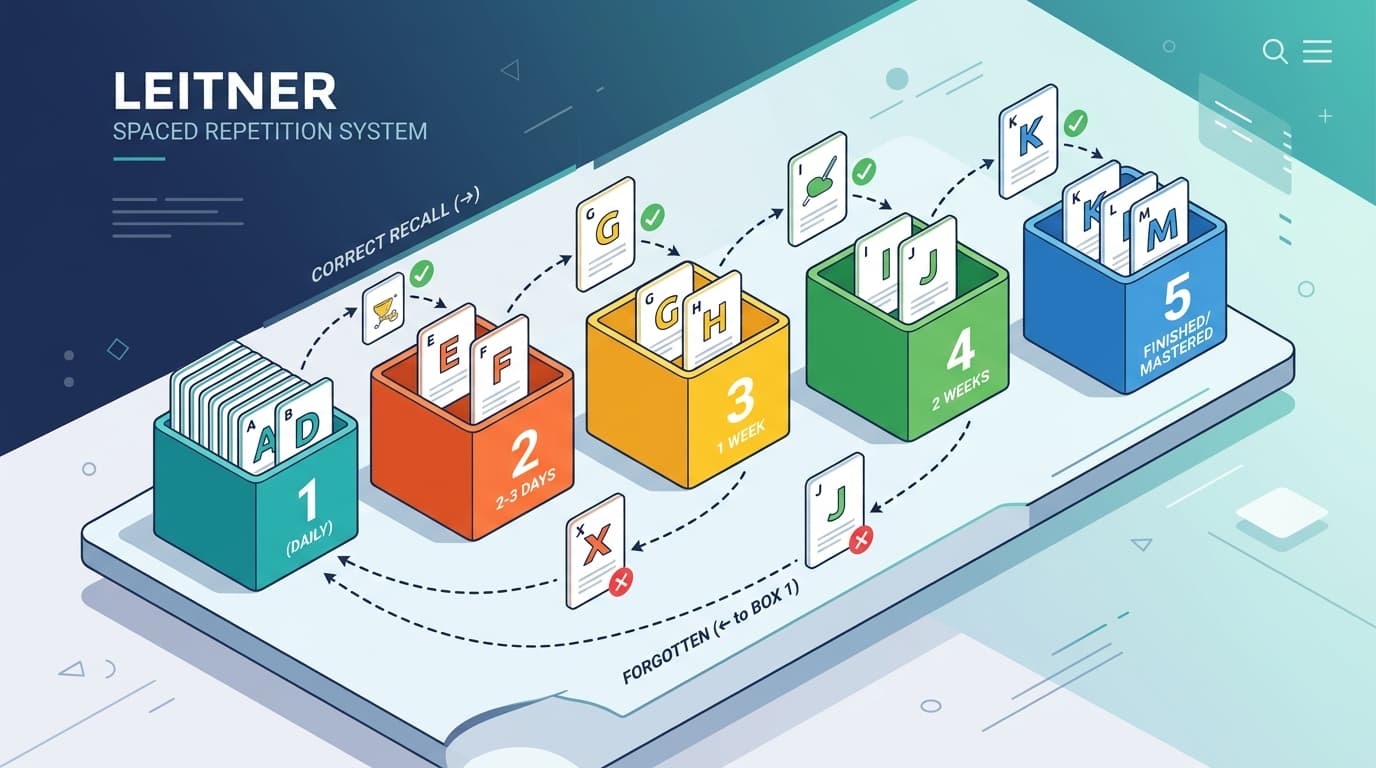
In 1972, German science journalist Sebastian Leitner published a book called So lernt man lernen ("Learning to Learn"). In it, he described a deceptively simple system for memorizing information using flashcards and a set of numbered boxes.
Half a century later, the Leitner system remains one of the most effective methods for vocabulary learning ever devised.
How the Leitner System Works
The concept is beautifully simple:
You have 5 boxes. All new cards start in Box 1.
The rules: - Get it right → the card moves to the next box (Box 1 → Box 2 → Box 3 → Box 4 → Box 5) - Get it wrong → the card drops back to Box 1, no matter where it was
The scheduling: - Box 1: Review every day - Box 2: Review every 2 days - Box 3: Review every 4 days - Box 4: Review every 8 days - Box 5: Review every 16 days (mastered)
That's it. No complex algorithms, no machine learning, no subscription required. Just boxes and rules.
Why It Works: The Science
The Leitner system works because it implements two well-established cognitive principles:
1. Spaced Repetition
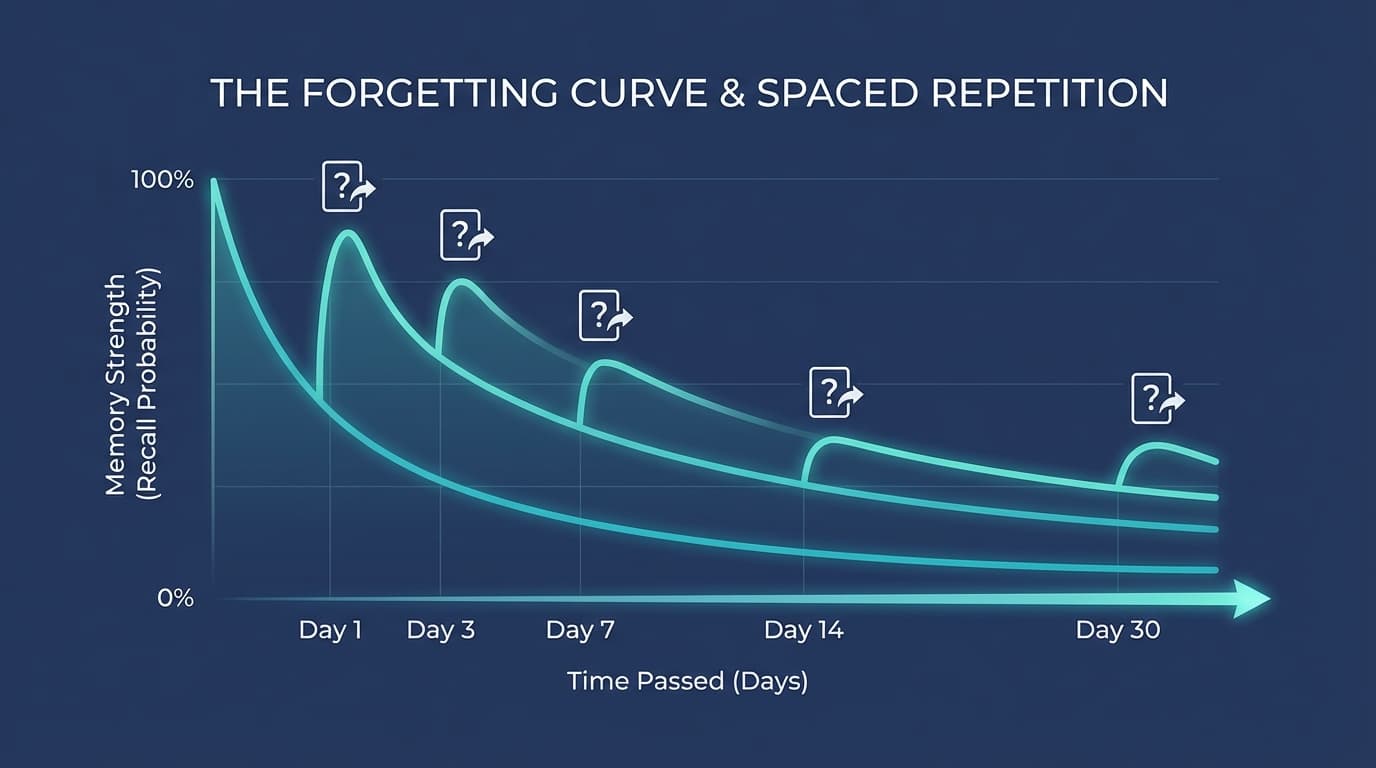
The spacing effect is one of the most robust findings in cognitive psychology. Reviewing information at increasing intervals produces dramatically better long-term retention than cramming.
If you study a word 5 times in one day, you'll remember it tomorrow but forget it next week. If you study it once today, once in 2 days, once in 4 days, once in 8 days, and once in 16 days — you'll remember it for months.
The Leitner boxes create these expanding intervals automatically.
2. Active Recall
Every time you look at a flashcard and try to remember the answer, you're practicing active recall — forcing your brain to retrieve information rather than passively re-reading it.
Research by Karpicke and Roediger (2008) showed that active recall produces 50% better retention than re-studying the same material.
The Leitner System for Language Learning
The system is particularly effective for vocabulary because:
Words you struggle with get more practice. Every incorrect answer sends the card back to Box 1, which is reviewed daily. You can't avoid your weak points — they keep coming back until you learn them.
Words you know get less practice. Once a card reaches Box 5, you're only reviewing it every 16 days. This frees up your daily study time for new words and difficult ones.
Progress is visible. You can literally see your cards moving through the boxes. Box 1 shrinking and Box 5 growing is tangible evidence of learning.
Common Mistakes with the Leitner System
1. Too many new cards at once. If you add 50 new cards to Box 1 today, you'll have 50 reviews tomorrow plus any that drop back. Start with 10-15 new cards per day.
2. Skipping review days. The intervals only work if you actually review on schedule. Missing a day compounds — Box 2 cards become overdue, mixed in with Box 1, and suddenly you have 80 reviews.
3. Cards that are too easy or too hard. A good flashcard has exactly one piece of information to recall. "What does 学 mean?" is good. "List all words containing 学" is too broad.
Digital Leitner Systems
The original Leitner system used physical boxes and paper cards. Modern implementations add:
- Audio — hear the word pronounced, not just see it written
- Adaptive intervals — adjust spacing based on how quickly you answered, not just right/wrong
- Progress tracking — charts showing your box distribution, retention rate, and learning velocity
- AI scheduling — a study coach that decides how many new cards to introduce based on your review backlog
How Insperium Uses the Leitner System
Insperium implements a 5-box Leitner system with a few key enhancements:
Audio on every card. You hear native pronunciation (Azure neural TTS) on every review, building listening skills alongside reading.
AI-managed pacing. The Study Coach monitors your box distribution. If too many words are piling up in Boxes 1-2, it slows down new word introduction automatically.
Leech detection. Words that repeatedly fall back to Box 1 (5+ failures) are flagged as "leeches" and get special treatment — including lookalike character comparison to identify the source of confusion.
Connected content. Words you're learning appear in graded sentences, stories, and dialogs — so you see them in context, not just on flashcards.
The result: all the proven effectiveness of the Leitner system, without the overhead of managing physical cards or tracking review schedules yourself.
References: - Leitner, S. (1972). So lernt man lernen. Herder. - Karpicke, J. D. & Roediger, H. L. (2008). The Critical Importance of Retrieval for Learning. Science, 319(5865). - Cepeda, N. J. et al. (2006). Distributed practice in verbal recall tasks. Review of General Psychology.